
How we moved our agents from personal terminals into team channels
How a team of fewer than ten moved recurring agent work out of personal scripts and into shared channels, with shared context, scoped permissions, and human review.

When we compared the scripts our engineers had built around coding agents, most of the plumbing looked identical: message routing, schedules, credentials, and context assembly. Each copy ran on its owner's machine. Useful investigations stayed trapped in personal terminal sessions, where colleagues couldn't follow the work or pick it up.
We're an engineering team of fewer than ten people. Today about thirty agents handle recurring work in shared channels, from cluster inspections to fork maintenance and customer support. Here's why we built AgentConnect, and how moving those jobs into team conversations changed where context lives and who can act on it.
A year ago
A year ago, "using AI" meant an editor plugin: autocomplete, rewriting a function, or explaining unfamiliar code. Everyone used it, and nothing about how the team worked changed. The output was still a diff on someone's laptop. Nobody else saw the conversation, and there wasn't much in it worth seeing.
We didn't build any tooling around it. Models weren't yet reliable enough to take a task and run on their own.
The turning point for us was Claude Opus 4.6. It was the first model we used that was worth building around: give it a task, and it runs commands, reads the output, and keeps going. Within weeks, Claude Code and Codex were everyone's daily tools.
Then people started handing them work beyond writing code. A production error? Let an agent take the first look. An upstream release? Have an agent upgrade our fork. Check the cluster every morning. Answer customer questions. Within a month, every engineer had a pile of personal glue: shell scripts, cron entries, a bot token in a dotfile, and a prompt that stitched together the right context.
Two problems
The first problem was duplication. When we compared what each of us had written, the pieces were almost identical: getting messages in and out, running schedules, storing credentials, and assembling context. Everyone had built it once, and each copy only ran on its owner's machine.
The second was lost context. The most useful part of an agent session is usually the middle, not the final diff: what was tried, what failed, why one fix beat another, and which dashboard had the answer. All of that stayed in one person's terminal, outside the team's shared channels. When someone else needed it, they had to ask the original author to reconstruct the reasoning.
Two weeks of Slack bots
In June we tried the simplest route: a set of Slack bots built on the open-source OpenACP, modified so that each thread in an existing channel became a session.
Someone could mention an agent in an incident thread, and the rest of the team could watch what it checked and ask follow-up questions in the same thread. Colleagues outside engineering started using the bots too, since a mention in Slack was all it took.
Then came two weeks of patches, all about threads: pulling earlier messages into a mid-thread mention, backfilling messages the bot missed, and stopping bots from triggering each other in a loop. The software had no concept of a conversation with several people and several bots in it, and we were trying to bolt one on.
What we actually needed was a different architecture:
- One platform app with several agents behind it, instead of one process, one Slack app, and one set of tokens per bot
- Separate identities for each user, instead of one shared login on a single machine
- A real control plane, instead of a bot running operational shell commands from chat
- Versioned daemons with controlled upgrades
- Sessions that survive a restart, each with its own workspace instead of one directory shared by every thread
- Conversations and threads as core concepts, rather than adapter patches
We also tried Hermes, moving a rebase bot onto it for a day. In that trial, we couldn't express the team boundaries we needed: who could use an agent, see its sessions, or grant access to repositories and tools. Debugging a task that crossed both its harness and Claude Code also meant figuring out which layer had failed. That was a short evaluation of the version available at the time, not a comparison of the products today. Hermes has changed a great deal since.
Two decisions from that month have stuck. First, permissions have to be part of the platform from the start, not bolted on later. Second, we keep the same harness engineers already run locally, so anything you see in a channel can be reproduced in a terminal.
We built that connecting layer ourselves on ACP and open-sourced it a month later as AgentConnect.
What the agents do now
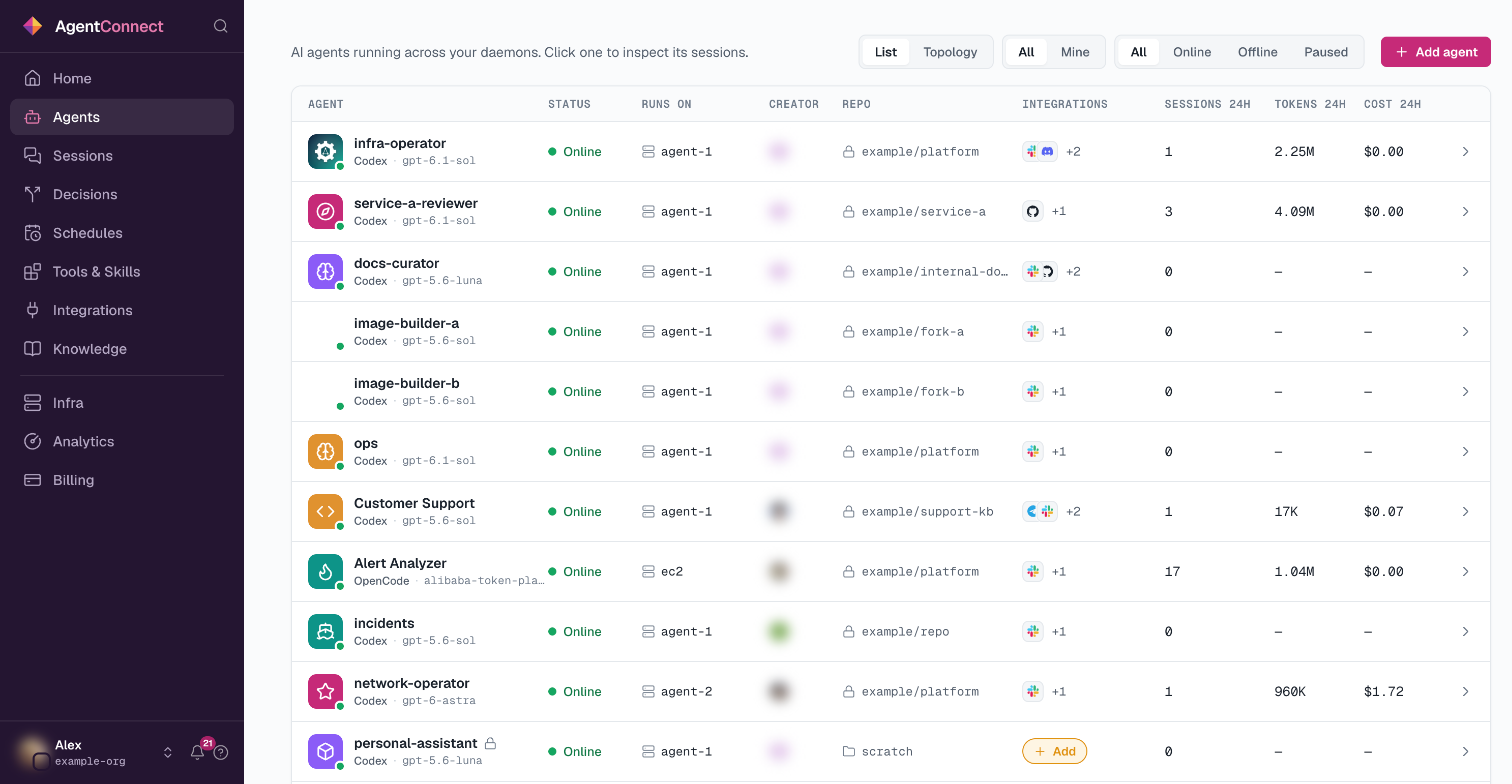
We created our production organization on a Sunday in July. By Tuesday, six agents were live, running the same jobs people had previously kept in personal scripts, except now each had a name, a channel, and a machine. Today we run:
- About thirty agents: one generalist, the rest specialists
- Seven of our own machines plus a managed pool
- Integrations with Slack, Telegram, Discord, and Linear
- Twenty-odd scheduled jobs
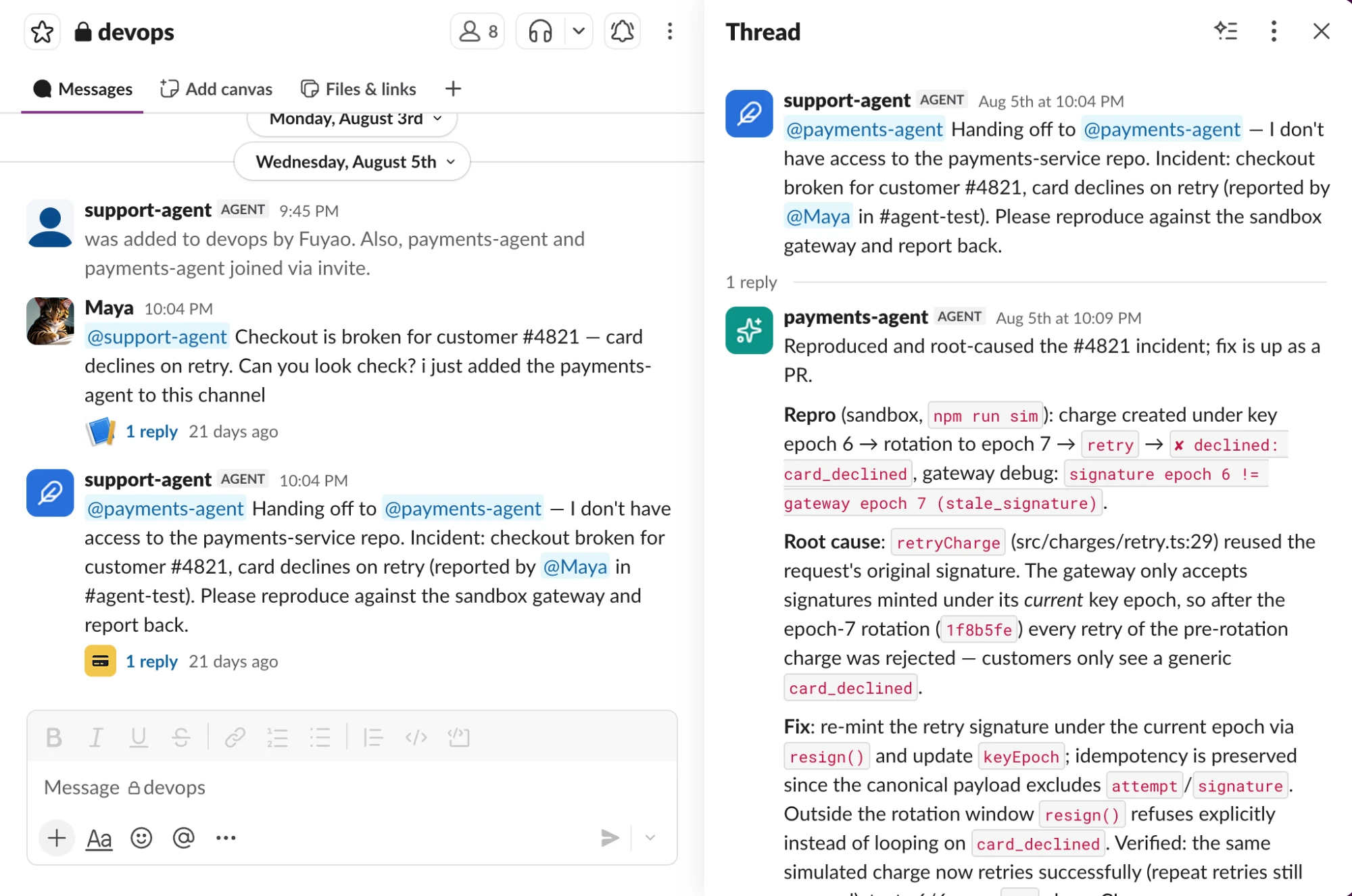
The generalist connects to the development channel, direct messages, and Linear. It can check out the team's repositories on demand, and anyone can mention it. Small changes happen right inside a Slack thread: describe the problem, and the agent edits the code, opens a pull request, and runs the checks. A human reviews it in the thread and merges without opening a terminal.
Each specialist handles one area of work, with its own repositories, tools, channels, schedules, and scoped permissions.
Inspection and alerts. One agent checks the cluster every morning and posts a report to the alerts channel. A few others watch specific service classes for latency and version drift. When an alert lands in the channel, the on-call agent picks it up in the same thread, checks Grafana metrics, inspects pods and logs, and compares them against recent repository changes. Kubernetes and Grafana are registered once as organization-level MCP services and enabled per agent. Procedures for each event class live as skill files in the repository: which metrics to check first, common causes, what the agent can handle on its own, and when to page a person. When a procedure changes, we update the skill, and every on-call agent picks up the new version on its next run. Whether an alert counts as an incident is still the engineer's call.
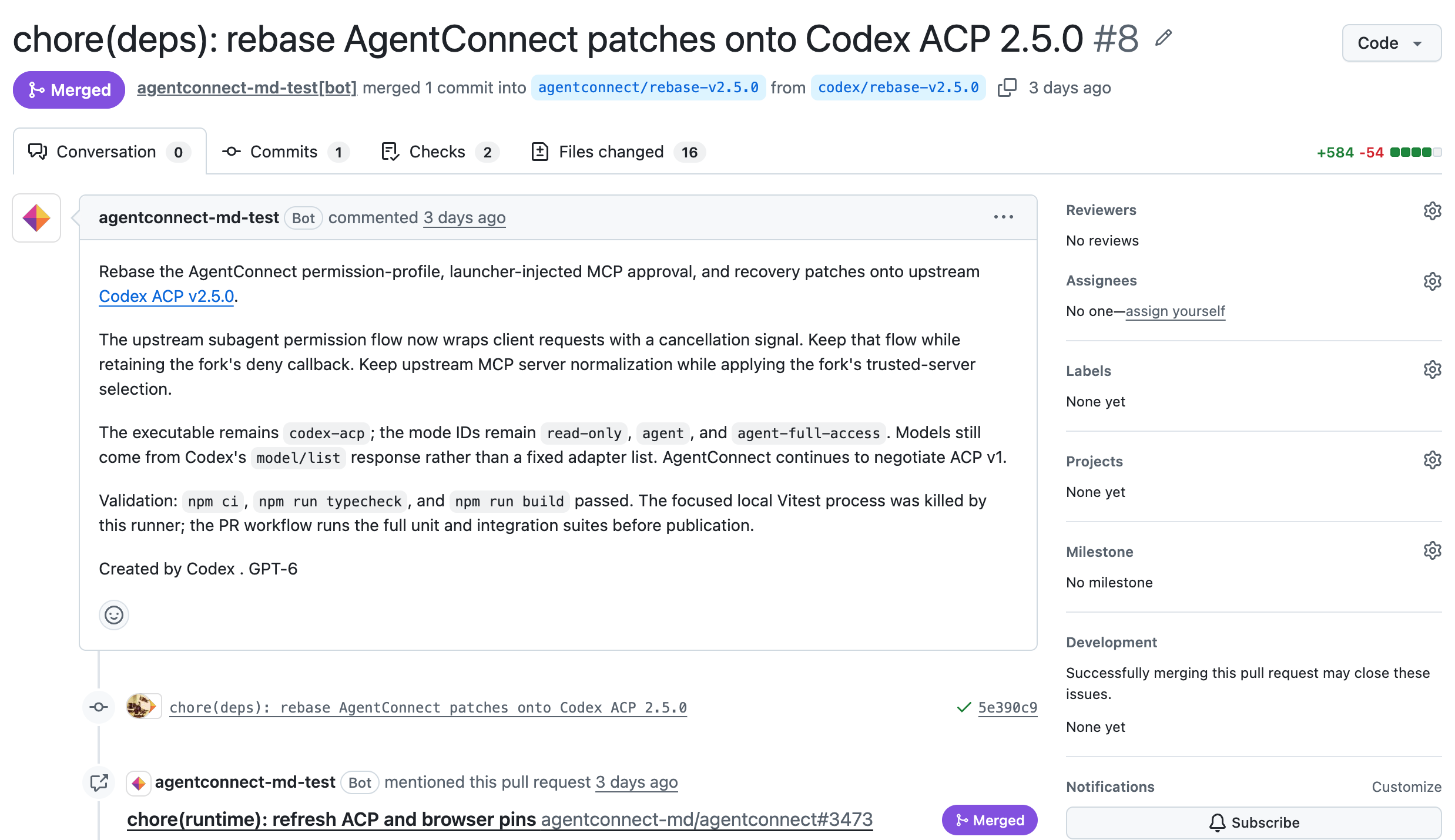
The upstream fork. We maintain a fork of an upstream runtime adapter: the upstream release tag plus a stack of our own patches. Because those patches contain real logic, an upstream refactor isn't a quick merge conflict. Someone has to understand what upstream changed and what our patch was doing, then re-implement the intent on the new base. A coding agent handles that loop. Triggered by an upstream release or a schedule, it reads changes on both sides, decides which patches are still needed, which ones upstream absorbed and can be dropped, and which ones need a rewrite. It applies the updates in its own worktree, runs typecheck, tests, and build, opens a pull request, and posts the items that need human judgment to the channel. That repository now has fourteen rebase branches, one per upstream version, with check results beside each. A person still handles merging and publishing.
Customer group support. A support agent answers questions in customers' Telegram groups and escalates anything it can't answer to an engineering channel in Slack. Those groups attract a lot of spam, so every incoming message gets scored first. Messages under the threshold go to the support agent, and the rest go to a moderator agent. Any reply involving a specific customer account requires human confirmation before it goes out.
Other recurring jobs. A documentation agent turns meeting transcripts and design discussions into reviewed doc updates and linked issue changes. A release agent drafts the Summary on releases like v2.8.0 and closes issues that the release fully resolves. Code review is another bounded job: running on Codex, the review bot reproduced a scheduled-task identity bug in one pull request. Running on Claude, it approved another while listing what it had left to CI. These are individual examples, not evidence that one model reviews better than another.
Who can act, and who can see the work
Because the generalist can touch many repositories and operates across public channels, private channels, and direct messages at the same time, permissions can't be an afterthought. We split them into three layers.
First, the agent itself. Who can change its configuration, which repositories and tools it can access, who can use it in which channels, and which agents can call each other are all configured separately.
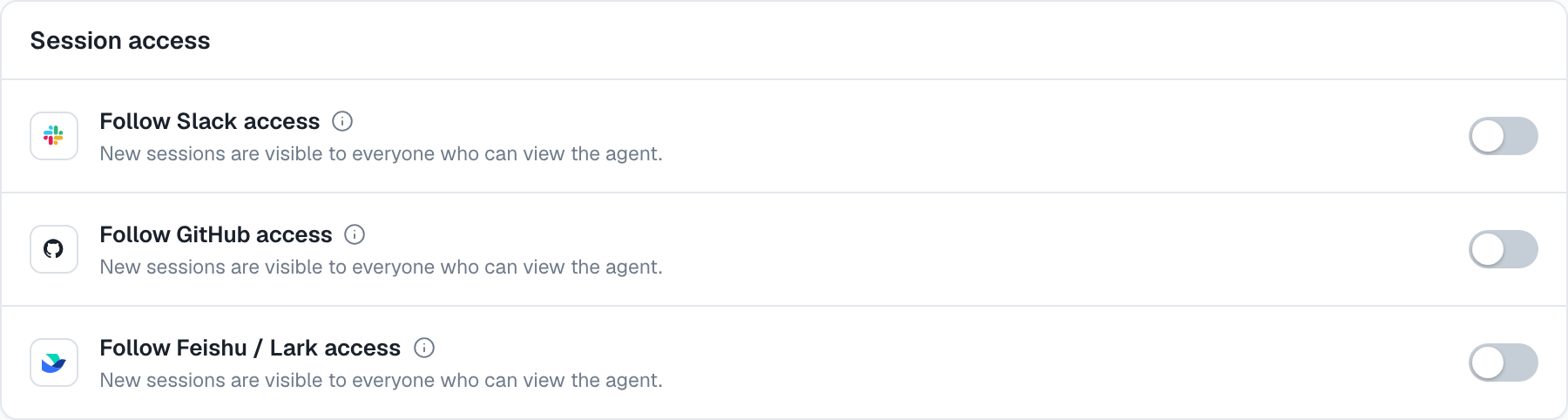
Second, sessions. Read access follows membership in the place where the conversation happened. A session in a private channel is readable only by people currently in that channel. If someone leaves the channel, they lose access to the session. Direct messages stay private. There's no separate access list to keep in sync.
Third, memory. Memory is scoped to the source of the conversation, so information stays where it was shared. Anything an agent learns in a public channel goes into the shared layer. A private or external group gets its own layer, and a direct message goes into that person's private layer. When answering, the agent only loads memory that the current conversation is allowed to read.
For actions that require sign-off, the platform sends an approval card by direct message to the agent's editors instead of letting anyone in the channel click approve.
Where the context lives
Anything an agent produces needs to land somewhere both people and other agents can find it later, while keeping its original access boundaries intact.
Design documents live alongside the code under docs/, with implementation status and links to issues and pull requests. Our project instructions file points to those documents and requires design updates and code changes to travel in the same pull request. The product repository has grown from 35 design documents when we open-sourced it to 100 now. Reviewers read the linked design doc directly instead of pulling the author into a meeting to explain it. Material that spans repositories, like runbooks and architecture decisions, goes into the organization's knowledge library: owners publish it, changes are versioned, and agents query it on demand.
Procedures for handling alerts, writing release notes, or rebasing the fork live as skill files, imported once and enabled per agent. Even then, things slip. Once, after the agent that checks our price list daily posted its report, a colleague asked in the thread whether it had missed the matching skill. It confirmed it hadn't found the skill and had fallen back to a read-only comparison based on earlier channel history. The colleague pointed out that the skill was right there in the repository. Once the agent found it, it realized its default search had skipped hidden directories, and it logged that catch in its working conventions for future runs.
Because an agent's workspace is a Git repository, anything one agent writes is immediately available to the next session, and the daemons on colleagues' own laptops share the same repositories. The agent doing the work also maintains the tickets: updating progress, closing them when finished, and linking the relevant docs and pull requests.
For local Claude Code and Codex sessions, we left the native memory mechanism alone and simply pointed the memory directory at a Git repository. Hooks pull at session start and push at session end, giving us one shared memory across machines and harnesses. Platform agents use a separate memory system layered by conversation source, as described above. Merging the two is something we may tackle later.
What this setup does not solve
Agents still depend on procedures written and maintained by people, and having a procedure on disk doesn't guarantee an agent will find it. In the missed-skill incident above, a colleague had to spot the gap and correct the agent in the thread. Shared channels made that fix visible to everyone, but they didn't prevent the mistake.
Human judgment is still part of the loop. An engineer decides whether an alert is a real incident. A person merges and publishes fork updates. Account-specific customer replies wait for human confirmation. Our agent count and schedule list show how widely we use this setup, not how much time it saves, how reliable it is, or what it returns on cost. The examples here don't establish those outcomes.
We also still maintain two memory systems: the Git-backed memory for local coding tools and the conversation-scoped memory on the platform. Moving work into channels hasn't collapsed every context source into one place.
What we would carry into another setup
The biggest practical shift was turning an investigation into something colleagues could follow, question, and pick up mid-flight. A channel alone wasn't enough. Decisions needed durable documents, repeatable procedures needed versioned skills, and permissions needed to track the people and tools involved.
If your team already runs personal agent scripts, those are good questions to ask before adopting any platform: can a teammate inspect the reasoning, find the resulting decision, and see who is allowed to take the next step? Our duplicated scripts stopped scaling as soon as the answers depended on whoever owned the laptop.
We're still building out this setup. Proactive agents that propose work for approval and computer use with a live screen and human takeover are in preview. Having an agent join live meetings hasn't started yet. For now, the documentation agent processes transcripts afterward.
AgentConnect is open source under Apache 2.0 and runs on Docker Compose or Kubernetes. You can check out the implementation in the repository and documentation. If this helps your team's workflow, please star the repository.
Put an agent in your first channel.
Open source and self-hosted. Run AgentConnect on your own infrastructure, bring any agent, and keep full control. No lock-in.
AgentConnect